English



Before starting mass production, approving label samples is an important step to ensure the final labels meet your product requirements. A proper sample evaluation can help identify potential issues early and avoid production delays, additional costs, or application problems.
Many customers focus only on the appearance of labels, but professional label evaluation should include printing quality, material performance, adhesive strength, and compatibility with your production process.
At Jinke Label, we recommend testing samples carefully before confirming bulk production.
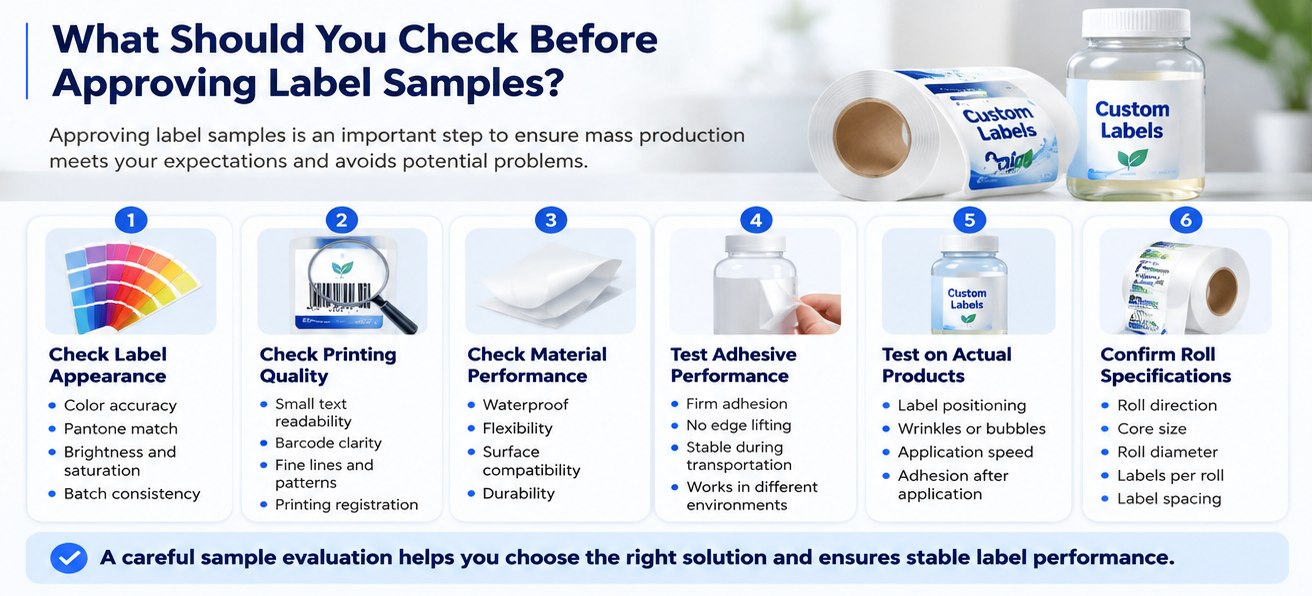
1. Check Label Appearance And Printing Quality
The first step is to check whether the label appearance matches your expectations.
Important points include:
Color Accuracy
Compare the sample with your approved artwork or reference sample.
Check:
For premium products such as beverages, cosmetics, and supplements, color accuracy is especially important because labels directly influence brand presentation.
Printing Details
Inspect:
High-quality printing ensures the label looks professional and functions properly.
2. Check Material Performance
Different products require different label materials.
During sample approval, consider:
Waterproof Performance
For products exposed to moisture, such as:
make sure the material can maintain appearance without wrinkling or peeling.
Flexibility And Surface Compatibility
The label should match the shape and surface of the container.
For example:
3. Test Adhesive Performance
Adhesive performance is one of the most important factors when approving label samples.
Check:
For special environments, such as freezing, refrigeration, or oily surfaces, standard adhesives may not be enough.
4. Test Labels On Actual Products
A label that looks good on a sample sheet may perform differently on the actual packaging.
We recommend testing samples on:
Check:
This step is especially important for customers using automatic labeling machines.
5. Confirm Roll Specifications For Production
For roll labels, make sure the sample matches your production requirements.
Important specifications include:
Incorrect roll specifications may cause problems during automatic labeling.
6. Review Packaging And Delivery Requirements
Before mass production, confirm:
Clear communication helps ensure smooth delivery.
Conclusion
Approving label samples is not only about checking the design. It is a complete evaluation of appearance, material, adhesive performance, and production compatibility.
A professional label supplier should help you confirm the right solution before mass production.
At Jinke Label, we support customers from sample testing to large-scale production, providing customized label solutions for beverage, food, cosmetic, healthcare, and industrial applications.
 +86 15805927008+86 15805928278
 Sales Executivelinda@jinkelabel.comSales Executiverosa@jinkelabel.comGeneral managerzane@jinkelabel.com
 No.99 Tongfu Road, Tongan district, Xiamen, China.

Our hours
Monday-Saturday: 8:00am-18:00pm