English



Thermal transfer printing is widely used for barcode labels, product identification, logistics labels, care labels and other variable information printing. A thermal transfer ribbon transfers ink onto the label material through heat from the printhead.
Choosing the right ribbon depends on the label material, printing conditions and the required resistance of the finished print.
This guide introduces the three main thermal transfer ribbon types—wax, wax-resin and resin—and explains how to match them with different label materials and printing requirements.
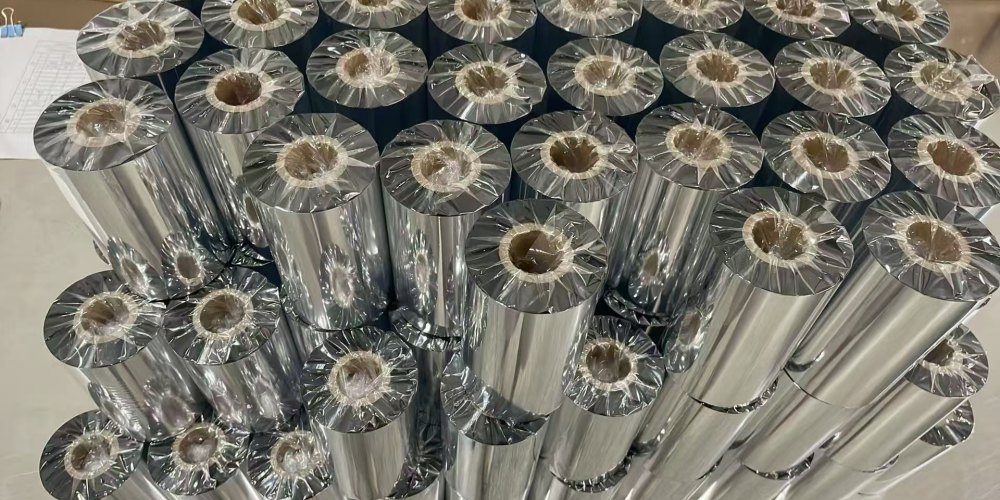
What Is a Thermal Transfer Ribbon?
A thermal transfer ribbon is generally made from a high-density polyester film coated with ink and other functional layers.
A typical ribbon consists of:
The heat-resistant layer helps protect the printhead and reduce friction and dust during printing. The ink layer contains pigments, resin, wax and other additives that influence transfer temperature, print quality and resistance.
The carrier film provides the mechanical strength needed during printing. Its thickness and strength can affect ribbon elongation and printing performance.
How Does Thermal Transfer Printing Work?
During thermal transfer printing, the printer's printhead generates heat. The heat melts the ink coating on the ribbon and transfers the ink onto the label surface.
Different ribbons have different sensitivities to heat. Therefore, printhead temperature, printing speed and ribbon characteristics need to be considered together.
The ribbon should also be matched with the label material to achieve the required print quality and durability.
Main Types of Thermal Transfer Ribbon
Thermal transfer ribbons can generally be divided into three main categories:
Wax Ribbon
Wax ribbons contain a higher proportion of wax and are generally used with uncoated paper and paper label materials.
They normally require a relatively lower printing temperature and offer lower resistance compared with resin-based ribbons.
| Characteristic | Wax Ribbon |
| Main ink composition | Higher wax proportion |
| Typical material | Uncoated paper and paper labels |
| Printing temperature | Relatively low |
| Resistance | Lower |
| Cost level | Lower |
| Typical use | General paper labels and barcode printing |
Wax-Resin Ribbon
Wax-resin ribbons combine wax and resin and provide a balance between printability and resistance.
They can be used with coated paper and care label materials. Compared with wax ribbons, they provide higher resistance and are suitable when the printed information needs greater durability.
| Characteristic | Wax-Resin Ribbon |
| Main ink composition | Wax and resin |
| Typical material | Coated paper and care labels |
| Printing temperature | Medium |
| Resistance | Higher than wax |
| Cost level | Medium |
| Typical use | Coated labels and applications requiring increased resistance |
Resin Ribbon
Resin ribbons contain a higher proportion of resin and are designed for applications requiring higher resistance.
They can be used with synthetic materials such as PVC and are suitable for applications where abrasion, smudging, chemicals or higher temperatures are concerns.
| Characteristic | Resin Ribbon |
| Main ink composition | Higher resin proportion |
| Typical material | PVC and other synthetic materials |
| Printing temperature | Relatively high |
| Resistance | High |
| Cost level | Higher |
| Typical use | Durable labels and synthetic materials |
Wax vs Wax-Resin vs Resin
The following table provides a quick comparison:
| Factor | Wax | Wax-Resin | Resin |
| Wax proportion | High | Around 50% | Less than 50% |
| Suitable materials | Uncoated paper | Coated paper, care labels | PVC and synthetic materials |
| Printing temperature | Lower | Medium | Higher |
| Print resistance | Lower | Medium to high | High |
| Abrasion resistance | Lower | Better | High |
| Chemical resistance | Lower | Better | High |
| Cost level | Lower | Medium | Higher |
The appropriate ribbon should be selected according to the actual label material and application requirements rather than simply choosing the lowest-cost option.
How to Match Thermal Transfer Ribbon with Label Material
Label surface characteristics are an important factor in ribbon selection.
For coated paper:
Wax or wax-resin ribbons can be considered depending on the required resistance.
For rougher paper surfaces:
Wax or mixed wax-resin ribbons may provide suitable transfer performance.
For PET and smoother synthetic materials:
Wax-resin or resin ribbons are generally more suitable.
For applications requiring higher durability:
Resin or wax-resin ribbons can be selected according to the required resistance.
| Label Material | Suggested Ribbon Type | Typical Consideration |
| Uncoated paper | Wax | General printing |
| Coated paper | Wax / Wax-Resin | Print quality and resistance |
| Care label | Wax-Resin | Increased resistance |
| PET | Wax-Resin / Resin | Smooth surface and durability |
| PVC | Resin | Higher resistance |
| Synthetic labels | Wax-Resin / Resin | Surface and application conditions |
Other Factors to Consider
Printing Speed
High-speed printing requires a ribbon with suitable sensitivity so that the ink can transfer effectively at the required printing speed.
Printhead Temperature
Ribbon sensitivity and printhead temperature need to be considered together. A suitable ribbon can help achieve the required transfer effect without unnecessarily increasing printing energy.
Abrasion and Chemical Resistance
If the printed barcode or variable information may be exposed to rubbing, solvents, chemicals or high temperatures, a more resistant ribbon such as resin or wax-resin may be required.
Barcode Clarity
For applications involving rotated or detailed barcodes, ribbon and label compatibility can affect the clarity of the printed information.
Ribbon Width
The ribbon width should generally be equal to or slightly wider than the label width. It should also remain within the printer's maximum ribbon width. Excessive width should be avoided.
Printer and Ribbon Compatibility
Thermal transfer ribbons are available in different winding directions and configurations.
Two common winding types are:
Different printhead types also require compatible ribbons, including:
These configurations should not be mixed without confirming printer compatibility.
Ribbon selection should therefore consider both the printer specification and the label material.
Thermal Transfer Ribbon Selection Checklist
Before ordering a thermal transfer ribbon, consider:
FAQ
What is the difference between wax and resin ribbon?
Wax ribbons contain a higher proportion of wax and are generally used for paper labels. Resin ribbons contain a higher proportion of resin and are used when higher resistance is required.
Which ribbon is suitable for paper labels?
Wax ribbons are commonly used for uncoated paper, while wax-resin ribbons can be considered for coated paper or applications requiring increased resistance.
Which ribbon should I use for PET labels?
Wax-resin or resin ribbons can be considered for PET depending on the required print durability and application conditions.
Does printing speed affect ribbon selection?
Yes. High-speed printing requires a ribbon with suitable sensitivity to achieve effective ink transfer.
Conclusion
Thermal transfer ribbon selection involves more than choosing between wax, wax-resin and resin. The label material, printer, printhead, printing speed and required resistance all need to be considered together.
Understanding these factors can help you select a ribbon that matches your label application and printing conditions.
For specific ribbon models and their applications, see our guide “Thermal Transfer Ribbon Applications and Product Selection Guide.”
 +86 15805927008+86 15805928278
 Sales Executivelinda@jinkelabel.comSales Executiverosa@jinkelabel.comGeneral managerzane@jinkelabel.com
 No.99 Tongfu Road, Tongan district, Xiamen, China.

Our hours
Monday-Saturday: 8:00am-18:00pm