Apr 28, 2026
As sustainability becomes a priority in the beverage industry, more brands are turning to wash-off labels—especially for reusable glass bottles.
But what exactly is a wash-off label, and why is it important?
1. What Is a Wash-Off Label?
A wash-off label is a type of label designed to be easily removed during the bottle washing process, typically using hot water or alkaline solutions.
Unlike standard labels, wash-off labels:
Stay firmly attached during use
Detach cleanly during recycling or reuse
2. How Do Wash-Off Labels Work?
The key lies in the special adhesive.
At room temperature → strong adhesion
In hot water or alkaline conditions → adhesive dissolves or releases
This allows labels to:
✔ Stay intact during storage and transportation
✔ Be removed quickly during industrial washing
3. Why Beverage Brands Use Wash-Off Labels
1). Reusable glass bottle systems
Wash-off labels make it easy to clean and reuse bottles.
2). Improved recycling efficiency
Labels can be removed without leaving residue.
3). Sustainability goals
Supports eco-friendly packaging strategies.
4. Typical Applications
Wash-off labels are commonly used for:
Beer bottles
Mineral water glass bottles
Soft drink glass packaging
Returnable bottle systems
5. Performance Testing (Very Important)
A good wash-off label must pass strict tests:
Ice water resistance
Long-time immersion
Hot water removal efficiency
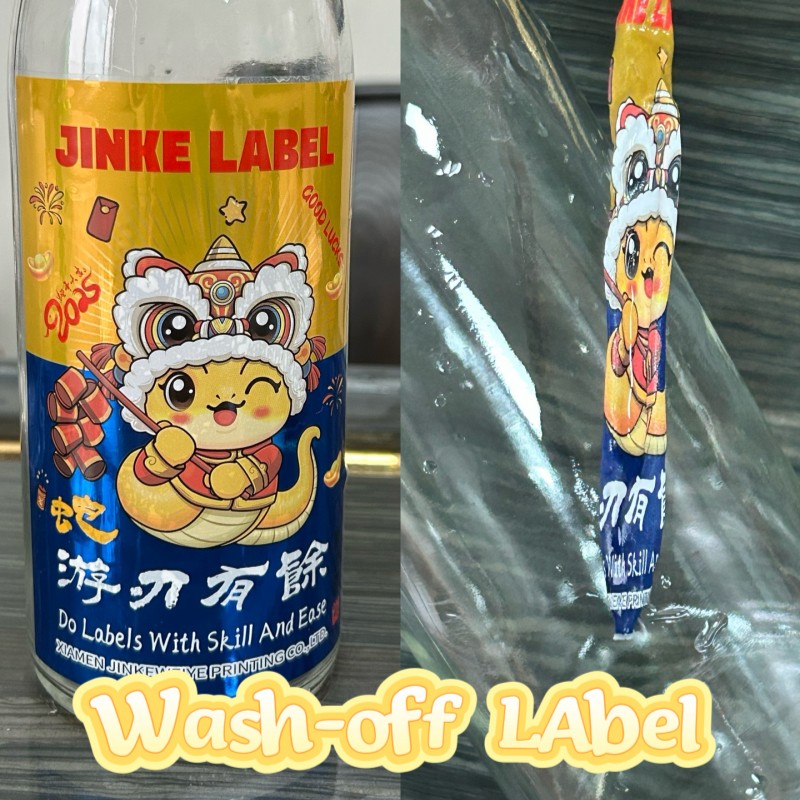
For example, in our testing:
Labels remain stable in ice water
Fully removable after soaking in hot water
👉 Testing is essential before mass production.
6. Common Mistakes to Avoid
Using standard adhesive instead of wash-off adhesive
Not testing under real conditions
Choosing incompatible materials
These can lead to:
Labels not removing properly
Residue left on bottles
Conclusion
Wash-off labels are an essential solution for beverage brands aiming for sustainability and efficiency in reusable packaging systems.
👉 Looking for wash-off label solutions?
We can provide material recommendations and sample testing based on your bottle and washing process.


 English



 +86 15805927008
 Sales Executivelinda@jinkelabel.com
 No.99 Tongfu Road, Tongan district, Xiamen, China.